

Control of mobile manipulators

Otilio_palo

Description

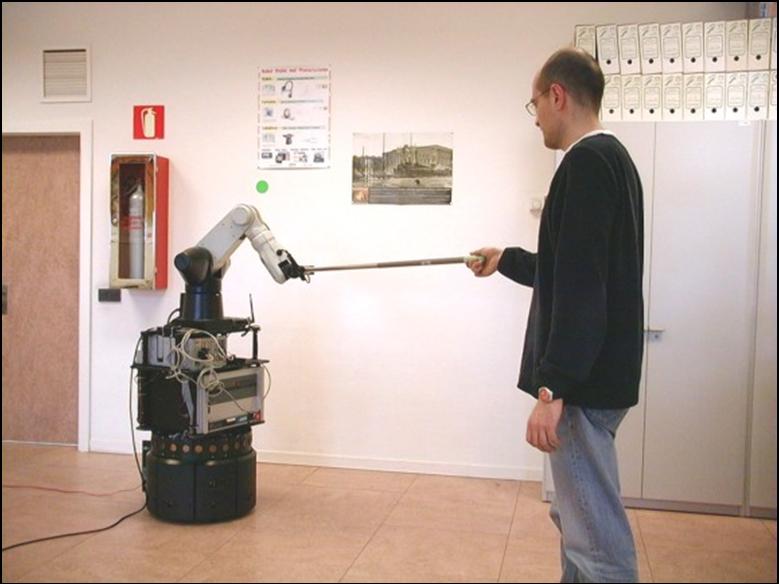
The force-torque control of mobile manipulator, and coordinated control of the mobile base and the manipulator permits to perform active human-mobile manipulator cooperation through intention recognition. The main implemented cooperative task is the transportation task to be held between human operator and the mobile manipulator. It is very useful for transportation of big or heavy parts. The roles of this cooperative transportation are: a) human is master and b) robot is slave through active robot cooperation.

The active cooperation steps that robot control need to perform are: a) signal processing of the 6D force-torque sensor in the tip of the robot by obtaining the observation windows, b) identification of the human master intention (turn left/right, push/pull, etc.) based on patterns recognition, and c) active robot Cartesian path generation by force addition.

Pattern recognition algorithm is as follows: when human master shows the intention of commanding an action (translation, height or orientation) certain spectral pattern appears in the sampled data (Fz, Mx, My). Pattern recognition algorithm has three steps: a) training, b) decoding, and c) evaluation. The used tool for pattern identification is the Hidden Markov Model (HMM). To correct identification of the human intention patterns the HMM training is necessary.

In the Hidden Markov Model the symbols of observation represent the 6D vectorial quantification of the spectral observation. The HMM state defines the status of the robot action through the force analysis, i.e. puling, etc.

Entries:
Synthesis of bisphosphonate derivatives of ATP by T4 RNA ligase
FEBS Lett. num. 24 , vol. 580 , pages: 5723 – 5727 , 2006
E. Silles
Synthesis of (di)nucleoside polyphosphates by the ubiquitin activating enzyme E1
FEBS Lett. num. 27 , vol. 579 , pages: 6223 – 6229 , 2005
E. Silles

Entries:
Elbow Functional Compensation using a Lightweight MagnetorheologicalClutch.
Annual International Conference of the IEEE EMBS Boston, MassachusettsUSA, 5215-5218., -,
A. Flores D. Copaci D. Blanco L. Moreno
Design of a controllable wheelchair for simulation of real life conditions
In Proceedings of the 6th International Conference of the International Society for Gerontechnology, Pisa, Italy
J.G. Quijano
A design methodology to allow scalability of EAP materials as actuators
3rd World Congress on Biomimetics, Artificial Muscles & Nano-Bio, 2006, Laussane, Switzerland
D. Fernandez L. Moreno
Characterization of IPMC using standard testing methods
Smart Structures and Materials., 2006, San Diego, USA
D. Fernandez L. Moreno
Actuator design using Electroactive materials
Smart Sensors Actuators and MEMS II. Microtechnologies for the New Millenium. , 2005, Sevilla, Spain
D. Fernandez L. Moreno
A bio-inspired EAP actuator design methodology
Smart Structures and Materials, 2005, San Diego, USA
D. Fernandez L. Moreno
Towards standarization of EAP actuator test procedures
Smart Structures and Materials, San Diego, USA
D. Fernandez L. Moreno
Electroactive Polymer Actuator design for space applications
8th ESA Workshop on Advanced Space Technologies for Robotics and AutomationASTRA 2004, 2004, ESTEC, Noordwik, Netherlands
D. Fernandez L. Moreno

Entries:
Image Analysis in Life Sciences
chapter: Imaging blood vessels with confocal microscopy for quantitative analysis Signpost , ISBN: 978-81-308-0312, 2009
S.M. Arribas M. Abderrahim

Previous Research topics

next Research topics