

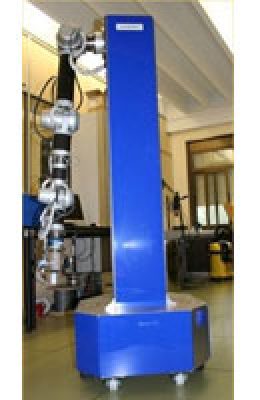
The project proposes the development of a set of techniques for mobile manipulators in the field of the 2D and 3D coherent motion planning, 3D sensorial acquisition by means of 2 motorised scanner laser, development learning system using Differential Evolution method and improvement of the experimental platform.
The first aim of this proyect is to develope coherent planning techniques able to unify in a single module the trajectory planning activity by using simultaneously all available information at the robot, the global environment map and the sensory data. In this way, the trajectory obtained from the robot?s position to the goal destination is data coherent because it uses all information instead of the non-coherent approaches which uses partial information in each module (the global map at global planning level, and the sensory data at navigation level). The integration of global planning and navigation in a single module will simplify the functional architecture of the robot, which let it deal with more complex task without an excesive increment in the functional complexity. On the other hand, the use of a unified and coherent treatment of the trajectory problem will improve the operational robustness of the whole system, because when a traditional approach is used the global planner generates (from the global map) a path non coherent with sensorial data, and the navigation module (from sensory data) generates local motion corrections non coherent with global map. The lack of coherency is traditionally solved by using a supervisor who monitorizes the path execution, and when a detour is considered excesive or the robot is blocked activates the global planner to estimate a new plan. This problem is more important in mobile manipulator case, because the tasks require to model, plan and operate in 3D environments.
The second objective of the project is to apply the Differential Evolution method to different learning and estimation problems in mobile manipulator tasks which require high robustness to uncertainty. This technique, a global stochastic optimizer has been used to solve the global localization problem. And is going to be used to solve SLAM problem, data alignment problem, the adaptation of learned manipulation tasks to positional errors in the actual execution of the task, and in the impedance control (force-torque) of manipulation tasks.