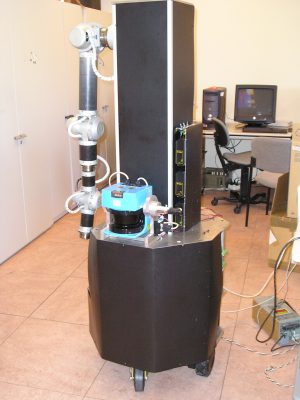
The main objective of Manfred Mobile Manipulator is the development of new capabilities to operate into the environment. The development of a new sensor-based planning and control architecture will allow the integration of sensor information coming from a laser scan, vision and a force/torque sensor. To reach this aim efficiently three complementary goals are required:
1. The functional architecture integrates perception, control, local and global planning in order to the mobile manipulator can cope with a wide spectrum of typical tasks required for a service robot operating in indoor environments (displacement in not cluttered areas, displacement in cluttered areas, door opening and collaboration with humans in the transport of a simple object). The architecture will be based on external sensor feedback for interaction control and sensor based local planning to achieve a proper combination of reactivity to environment and smoothness in interaction control with objects.
2. The interaction control system is based on a sensorial feedback of an impedance control. By introducing the positional error between the arm end effector and the object as sensor feedback in the impedance control loop, the tolerance to position uncertainty of the mobile manipulator will be improved considerably. The force control strategy will be based on an impedance control due to the object to manipulate are not exactly the same and the task will be sporadically done.
3. The perception system is based on a laser scanner (2D and 3D) and vision (one in hand and a frontarl camera) used to solve the displacements and approximation problems, and a vision system will be used to estimate the positional error during the interaction task.