

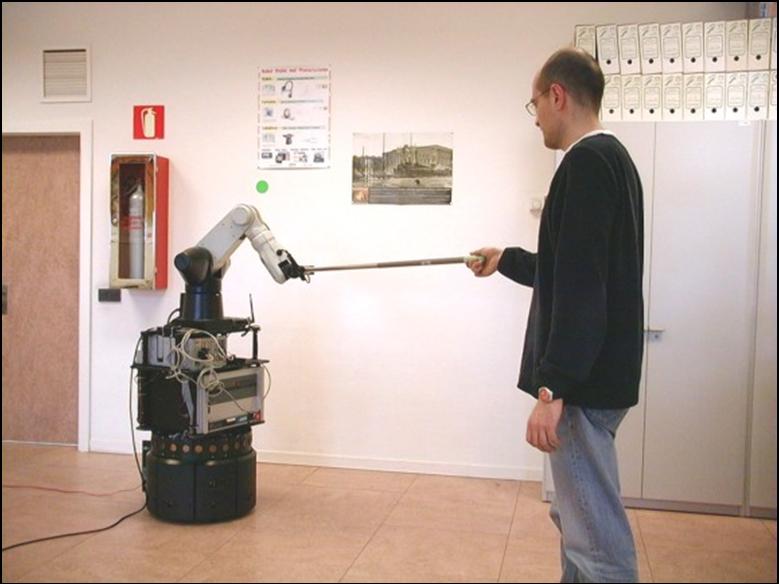
The force-torque control of mobile manipulator, and coordinated control of the mobile base and the manipulator permits to perform active human-mobile manipulator cooperation through intention recognition. The main implemented cooperative task is the transportation task to be held between human operator and the mobile manipulator. It is very useful for transportation of big or heavy parts. The roles of this cooperative transportation are: a) human is master and b) robot is slave through active robot cooperation.
The active cooperation steps that robot control need to perform are: a) signal processing of the 6D force-torque sensor in the tip of the robot by obtaining the observation windows, b) identification of the human master intention (turn left/right, push/pull, etc.) based on patterns recognition, and c) active robot Cartesian path generation by force addition.
Pattern recognition algorithm is as follows: when human master shows the intention of commanding an action (translation, height or orientation) certain spectral pattern appears in the sampled data (Fz, Mx, My). Pattern recognition algorithm has three steps: a) training, b) decoding, and c) evaluation. The used tool for pattern identification is the Hidden Markov Model (HMM). To correct identification of the human intention patterns the HMM training is necessary.
In the Hidden Markov Model the symbols of observation represent the 6D vectorial quantification of the spectral observation. The HMM state defines the status of the robot action through the force analysis, i.e. puling, etc.