

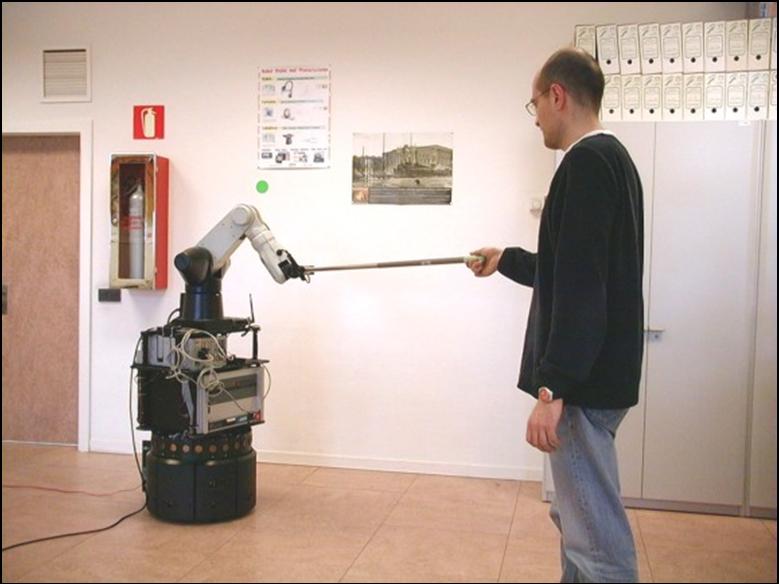
Control of mobile manipulators

Otilio_palo

Description

The force-torque control of mobile manipulator, and coordinated control of the mobile base and the manipulator permits to perform active human-mobile manipulator cooperation through intention recognition. The main implemented cooperative task is the transportation task to be held between human operator and the mobile manipulator. It is very useful for transportation of big or heavy parts. The roles of this cooperative transportation are: a) human is master and b) robot is slave through active robot cooperation.

The active cooperation steps that robot control need to perform are: a) signal processing of the 6D force-torque sensor in the tip of the robot by obtaining the observation windows, b) identification of the human master intention (turn left/right, push/pull, etc.) based on patterns recognition, and c) active robot Cartesian path generation by force addition.

Pattern recognition algorithm is as follows: when human master shows the intention of commanding an action (translation, height or orientation) certain spectral pattern appears in the sampled data (Fz, Mx, My). Pattern recognition algorithm has three steps: a) training, b) decoding, and c) evaluation. The used tool for pattern identification is the Hidden Markov Model (HMM). To correct identification of the human intention patterns the HMM training is necessary.

In the Hidden Markov Model the symbols of observation represent the 6D vectorial quantification of the spectral observation. The HMM state defines the status of the robot action through the force analysis, i.e. puling, etc.

Entries:
Real-Time Gait Planning for Rh-1 Humanoid Robot Using Local Axis Gait Algorithm
International Journal of Humanoid Robotics. Print ISSN: 0219-8436. Online ISSN: 1793-6942. num. 1 , vol. 6 , pages: 71 – 91 , 2009
M. Arbulu
The Rh-1 full-size humanoid robot: design, walking pattern generation and control
Journal of Applied Bionics and Biomechanics (Print ISSN: 1176-2322, Online: ISSN: 1754-2103). num. 3 , vol. 6 , pages: 301 – 344 , 2009
M. Arbulu D. Kaynov L.M. Cabas

Entries:
Aiming for multibody dynamics on stable humanoid motion with Special Euclideans groups, called SE(3) (Accepted)
2010 IEEE/RSJ International Conference on Intelligent Robots and Systems (IROS 2010), Taipei, Taiwan
M. Arbulu S. Martinez A. Jardon C.A. Monje
Aiming for Multibody Dynamics on Stable Humanoid Motion with Special Euclidean Groups
2010 IEEE/RSJ International Conference on Intelligent Robots and Systems, IROS’2010, 2010, Taipei, China
M. Arbulu S. Martinez A. Jardon C.A. Monje
Optimal gait synthesis of biped robot pasibot using artificial intelligence based predictive control
12th International Conference on Climbing and Walking Robots (Clawar'09), Istanbul,
J.G. Quijano A. Jardon
K., Yokoi, A., Kheddar, C., Balaguer<br>Dynamic acyclic motion from a planar contact-stance to another
IEEE/RSJ 2008 International Conference on Intelligent Robots and Systems, Nice, France
M. Arbulu
Real -Time gait planning for Rh-1 humanoid robot, using Local Axis Gait algorithm
IEEE-RAS International Conference on Humanoid Robots (Humanoids'2007), Pittsburg-Pensi, USA
M. Arbulu
Trends of new robotics platform, designing Humanoid Robot Rh-1
CARS & FOF 0723rd ISPE International Conference on CAD/CAM Robotics and Factories of the Future, 2007, Bogota, Colombia
M. Arbulu D. Kaynov L.M. Cabas P. Staroverov
Nuevas tendencias en plataformas de robótica, caso robot humanoide Rh-1
Intercon 2007XIV Congreso Internacional de Ingeniería Eléctrica, Electrónica y Sistemas, 2007, Piura, Peru
M. Arbulu D. Kaynov L.M. Cabas P. Staroverov
Rh-0 humanoid full size robot`s control strategy based on the Lie logic technique
IEEE-RAS International Conference on Humanoid Robots (Humanoids'2005), 2005, Tsukuba, Japan
M. Arbulu D. Kaynov J. M. Pardos-Gotor P. Staroverov
Rh-0 Humanoid Robot Bipedal Locomotion and Navigation Using Lie Groups and Geometric Algorithms
International Conference on Intelligent Robots and Systems (IROS'2005), Edmonton, Canada
J. M. Pardos-Gotor
Inverse Dynamics of Humanoid Robot by Balanced Mass Distribution Method
IEEE/RSJ International Conference on Intelligent Robots and Systems (IROS'2004), 2004, Sendai, Japan
M. Arbulu
User friendly graphical environment for gait optimization of the humanoid robot Rh-0
7tn International Conference on Climbing and Walking Robots (Clawar'2004), 2004, Madrid, Spain
M. Arbulu P. Staroverov
Humanoid Robot Kinematics Modeling Using Lie Groups
7th International Conference on Climbing and Walking Robots (Clawar'2004), Madrid, Spain
J. M. Pardos-Gotor

Previous Research topics

next Research topics