

Robotic hands

Robot_hands

Description

Introduction
Many research areas exist in Robotics, for example, the developement of robotic arms, manipulator robots, humanoids and robots created for disable people´s assistance.
A common caracteristic between all those robots is the need of a manipulator which allows it to fulfil certain tasks. This manipulator should be universal in order to give the robot the possibility of being used in as many tasks as the user may want or need. For that reason, the objetive of imitating the human hand grows: it is the best manipulator created by Nature.
Currently, The Robotic´s Lab has two projects:

  • RL1 Hand
  • UC3M Hand

RL1 Hand
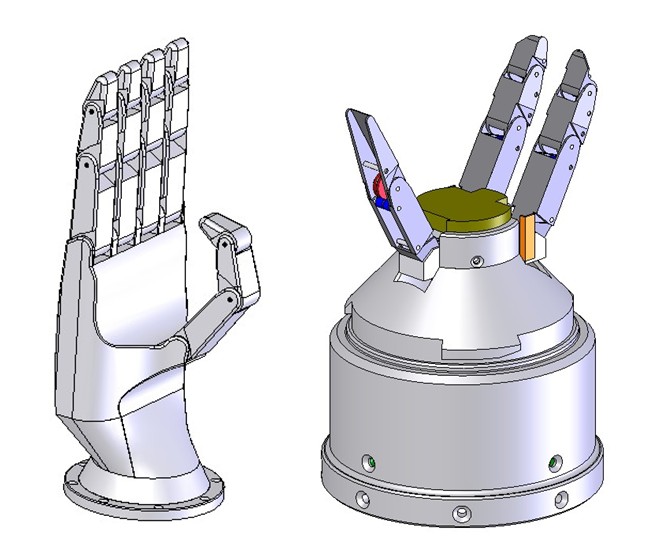
The RL1 Hand is a Robotic Claw design to be mounted on the ASIBOT Robot for helping disable people. Due to the fact that the claw was expected to fit inside the Robot´s Docking Station it had to reach certain caracteristics. A Docking Station is a mechanism that allows the robot to trasnsport throught different enviroments; this feature makes the ASIBOT Robot a climbing robot.


The movement to make the claw pass from a resting state (inside the Docking Station) to a operative state, requires a high complexity internal mechanism. This movement is achieved by only one electrical motor, situated inside the Docking Station with the electronic that controls the claw.

The RL1 Hand´s fingers are able to adapt to the objects shape; this guarantee a firm holding in all cases. The three finger are activated by tendons guide throght pulleys.

The RL1 Hand recives specific instructions given by the ASIBOT Robot, throght the serial port.

Nowadays, a second version of the RL1 Hand is being developed (RL2 Hand), focusing on certain mechanisms optimizations which are expected to make the hand more robust.

UC3M Hand

This project is focused on the development of robotic hand capable of being mounted on the RH0 Humanoid. For that reason, the robotic hand needs to fulfil certain requirements, such us:

  • Modular configuration
  • Low weight (less than 700 gr.)
  • High dexterity

To achieve those requirements, certain objetives have been fixed:

  • All the movements must be governed by only one electrical motor
  • The UC3M Hand must contain all the mechanism and the electrical motor
  • The Humanoid must send simple instruccions to the UC3M Hand to control all its tasks

The objetives mentioned above will be reached by the design of an specific actuator and special mechanisms with a complex coontrol.

Entries:
High-Accuracy Global Localization Filter for Three-Dimensional Environments
Robotica, http://dx.doi.org/10.1017/S0263574711000701. num. 3 , vol. 30 , pages: 363 – 378 , 2012
F. Martín S. Garrido D. Blanco L. Moreno
Diseño y simulación de un actuador de rigidez variable
Anales de Ingeniería Mecánica: Revista de la Asociación Española de Ingeniería Mecánica; ISSN: 0212-5072. num. 18 , vol. 1 , pages: 154 – 161 , 2012
A. Gimenez A. Jardon López, J. García, D.
Compact modeling technique for outdoor navigation
IEEE Transactions on Systems, Man, and Cybernetics-Part A (ISSN: 1083-4427). num. 1 , vol. 38 , pages: 9 – 24 , 2008
D. Blanco L. Moreno
Desarrollo de un sistema de percepción de una plataforma móvil para entornos exteriores
Revista Iberoamerica de Ingeniería Mecánica (ISSN : 1137-2729). num. 3 , vol. 8 , pages: 3 – 23 , 2004
D. Blanco L. Moreno

Entries:
Topographical analysis for Voronoi-based modelling
28th Annual Conference of the IEEE Industrial Electronics SocietyIECON 2002, 2002, Seville, Spain
L. Moreno
Voronoi Extraction of Free-way Areas in Cluttered Environments
2005 IEEE/RSJ Int. Conf. on Intelligent Robots and Systems (IROS2005), Edmonton, Canada
D. Blanco L. Moreno
Traversability analysis technics in outdoor environments: a comparative study.
11th International Conference on Advanced Robotics, ICAR 2003, 2003, Coimbra, Portugal
D. Blanco L. Moreno
Traversable regions model for outdoor robots.
11th International Conference on Advanced Robotics, ICAR 2003 , 2003, Coimbra, Portugal
D. Blanco L. Moreno
Estimación de Suelos Navegables para Interiores
11th Workshop Robocity 2030: Robots personales y asistenciales, 2013, Madrid, Spain
J.V. Gomez D. Alvarez L. Moreno
Localization in 3D Environments Using DifferentialEvolution
2009 IEEE International Symposium on Intelligent Signal Processing (WISP'2009), Budapest, Hungary
F. Martín S. Garrido D. Blanco L. Moreno
Accelerated Localization in Noisy 3D Environments usingDifferential Evolution
The 2010 International Conference on Genetic and Evolutionary Methods, Las Vegas, USA
C. G.Uzcategui F. Martín D. Blanco L. Moreno
Differential Evolution approach to the grid-based Localization and Mapping problem
2007 IEEE International Conference on Intelligent Robots and Systems (IROS'2007), California, USA
F. Martín S. Garrido L. Moreno
L1-norm global localization based on a Differential Evolution Filter
2009 IEEE International Symposium on Intelligent Signal Processing (WISP'2009), Budapest, Hungary
M.L. Muñoz F. Martín S. Garrido D. Blanco L. Moreno
Modelado de zonas cruzables para la navegación segura de robots en entornos exteriores
2º Workshop de RoboCity 2030, Robot de exteriores, 2007, Ávila, España
D. Blanco L. Moreno
Evolutionary Filter for Mobile Robot Global Localization
2007 IEEE International Symposium on Intelligent Signal Processing (WISP'2007), 2007, Alcala Henares, Spain
F. Martín S. Garrido L. Moreno
E-SLAM solution to the grid-based Localization and Mapping problem
2007 IEEE International Symposium on Intelligent Signal Processing (WISP'2007), 2007, Alcala Henares, Spain
F. Martín S. Garrido L. Moreno
Rh-0 Humanoid Robot Bipedal Locomotion and Navigation Using Lie Groups and Geometric Algorithms
International Conference on Intelligent Robots and Systems (IROS'2005), Edmonton, Canada
J. M. Pardos-Gotor

Entries:
Innovations in Robot Mobility and Control
chapter: Voronoi-based outdoor traversable region modelling pages: 201 – 250. Springer-Verlag , ISBN: 3-540-26892-8, 2005
D. Blanco L. Moreno

Previous Research topics

next Research topics