

ROSES

Robots sociales para la estimulación física, cognitiva y afectiva de mayores

Main researcher: M. Malfaz

mini

Description

Human life expectancy has been continuously increasing during last decades, and many developed countries, inside and outside Europe, face the great problem of having an aging population. The inverted pyramid of population implies having more elders than young people who can take care of them. New technologies, particularly robots, can be very useful to alleviate this problem.

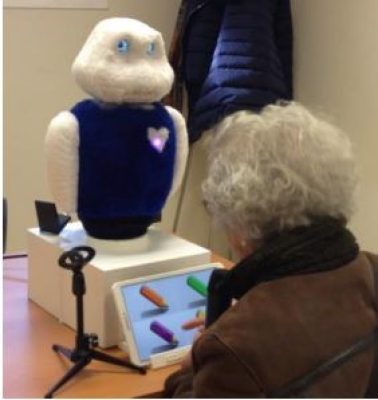
This project continues the line of work of the research group in the field of social robotics and, in particular, in the application of social robots to help elderly people. In the previous national project, ROBSEN (DPI2014-57684-R), we studied the possibilities that social robots can offer to help elders with cognitive impairment. In that project, we developed a robot endowed with functions oriented towards entertainment, company, monitoring, personal assistance, and a first approach to cognitive stimulation activities. As a result of this project, it was found that social robots can also offer great possibilities as an element of stimulation for elders. For this reason, this new project is going to deepen specifically in this application.

The ultimate goal of this new project, like the previous one, is still to continue studying the use of social robots to improve the quality of life of the elderly. In order to maintain the wellbeing of the elderly for longer, it is essential that they remain active, both mentally and physically. Besides, maintaining a positive emotional state is also very important for mental health. Considering all this, this project focuses on the development of several social robots endowed with physical, emotional and cognitive stimulation skills. As will be detailed in the specific objectives section, we propose the construction of 3 types of social robots: Mini-type robot (developed under the previous project), a pet-robot and a mobile robot. Due to the particularities of the users of this project, their functionalities and features will be specified throughout the project under the supervision of experts in the elderly, as will be detailed in the project methodology and the workplan.

Entries:
End-User Programming of a Social Robot by Dialog
Robotics and Autonomous Systems. (Online). num. 12 , vol. 59 , pages: 1102 – 1114 , 2011
Javi F. Gorostiza M.A. Salichs
Using MUDs as an experimental platform for testing a decision making system for self-motivated autonomous agents
Artificial Intelligence and Simulation of Behaviour Journal (AISBJ).. num. 1 , vol. 2 , pages: 21 – 44 , 2010
M. Malfaz M.A. Salichs
Human-Robot Interfaces for Social Interaction
International Journal of Robotics and Automation. , 2006
A.M. Khamis M.A. Salichs

Entries:
Use of RFID technology on a mobile robot fortopological navigation tasks
IEEE International Conference on RFID-Technologies and Applications, 2011, Sitges, Spain
A. Corrales M.A. Salichs
Selection of Actions for an Autonomous Social Robot
International Conference on Social Robotics. Best Student Paper Finalist (http://dx.doi.org/10.1007/978-3-642-17248-9_12), 2010, Singapore, Singapore
A. Castro-Gonzalez M. Malfaz M.A. Salichs
The Use of Emotions in an Autonomous Agent’s Decision Making Process
Ninth International Conference on Epigenetic Robotics: Modeling Cognitive Development in Robotic Systems (EpiRob09), Venice, Italy
M. Malfaz M.A. Salichs
Teaching Sequences to a Social Robot by Voice Interaction
RO-MAN 09 : 18th IEEE International Symposium on Robot and Human Interactive Communication , 2009, Toyama, Japan
Javi F. Gorostiza M.A. Salichs
Infrared Remote Control with a Social Robot
FIRA RoboWorld Congress 2009. International Conference on Social Robotics (http://dx.doi.org/10.1007/978-3-642-03986-7_10), 2009, Incheon, Korea
A. Castro-Gonzalez M.A. Salichs
Gestión de estados básicos para el robot Maggie
4º Workshop RoboCity2030. Robots personales y asistenciales., 2008, Leganés, Spain
A. Castro-Gonzalez M.A. Salichs
Robot Skill Abstraction for AD Architecture
6th IFAC Symposium onIntelligent Autonomous Vehicles IAV 2007, 2007, Toulouse, 2007
A. Corrales R. Rivas R. Barber M.A. Salichs
Using Emotions for Behaviour-Selection Learning
The 17th European Conference on Artificial Intelligence. ECAI 2006, 2006, Riva del Garda, Italy
M. Malfaz M.A. Salichs
Maggie: A Robotic Platform for Human-Robot Social Interaction
IEEE International Conference on Robotics, Automation and Mechatronics (RAM 2006), 2006, Bangkok, Thailand
E. Delgado A. Corrales R. Rivas R. Pacheco A.M. Khamis Javi F. Gorostiza M. Malfaz R. Barber M.A. Salichs
Emotion-Based Learning of Intrinsically Motivated Autonomous Agents living in a Social World
International Conference on Development and Learning 2006. ICDL5, 2006, Bloomington, In, USA
M. Malfaz M.A. Salichs
Learning Behaviour-Selection Algorithms for Autonomous Social Agents living in a Role-Playing Game
Narrative AI and Games, part of AISB'06: Adaptation in Artificial and Biological Systems. University of Bristol, Bristol, England
M. Malfaz M.A. Salichs
Using Emotions on Autonomous Agents. The Role of Happiness, Sadness and Fear
Integrative Approaches to Machine Consciousness, part of AISB'06: Adaptation in Artificial and Biological Systems, Bristol, England
M. Malfaz M.A. Salichs

Entries:
Design and Control of Intelligent Robotic Systems
chapter: Path planning inspired on emotional intelligence pages: 119 – 132. Springer-Verlag Berlin Heidelberg , ISBN: 978-3-540-89932, 2009
V. Egido M. Malfaz R. Barber M.A. Salichs
Progress in Robotics. Communications in Computer and Information Science 44
chapter: Infrared Remote Control with a Social Robot pages: 86 – 95. Springer , ISBN: 978-3-642-03985, 2009
A. Castro-Gonzalez M.A. Salichs
Robots personales y asistenciales
chapter: ASIBOT: robot portátil de asistencia a discapacitados. Concepto, arquitectura de control y evaluación clínica pages: 127 – 144. Universidad Carlos III de Madrid , ISBN: 978-84-691-3824, 2008
R. Pacheco R. Correal A. Gimenez S. Martinez A. Jardon R. Barber M.A. Salichs
Progress in Robotics.
chapter: Integration of a RFID System in a Social Robot. pages: 66 – 73. Springer Berlin Heidelberg , ISBN: 978-3-642-03986, 1999
A. Corrales M.A. Salichs

Previous Project

next project