

Although advances in robotics have been undisputed for the past 50 years, robots made of
rigid materials still have many limitations. Nowadays, there exists a new trend on biologically
inspired robots with “soft” elements that are able to perform tasks which are not available to
robots with rigid limbs. This new paradigm is known as Soft Robotics and is presented as an
innovation beyond already existing flexible robots or other robots that include variable
stiffness actuators (VSA). The technological challenge is in the incorporation of soft links into
the robotic structure. This way, the MAR2016 (Multi-Annual Roadmap) of euRobotics
remarks as one of the most important interdisciplinary challenges of modern robotics “the
design of soft robotics”.
In the case of humanoid robotics, and in comparison with a rigid design, a robot with soft
links has the following main advantages: a) simplicity of design, favouring an underactuated
architecture without the need of increasing the number of degrees of freedom; b) increased
accessibility and adaptability to complex environments, with a postural control that can hardly
be implemented in rigid robots; and c) safer interaction with the human and the environment,
with a high level of absorption of possible impacts, increasing the stability of the robot.
Currently, there are several international projects for the design and use of soft robots:
1)OCTOPUS (SSSA, Italy), devoted to the design of submarine soft robots
with large manipulation capabilities; 2) COMANOID (CNRS, France), for robot access to
constrained spaces during assembly operations in the fuselage of an airplane; and 3)
JUSTINew (DLR, Germany), for the improvement of the perception of a humanoid robot by
the integration of a soft neck.
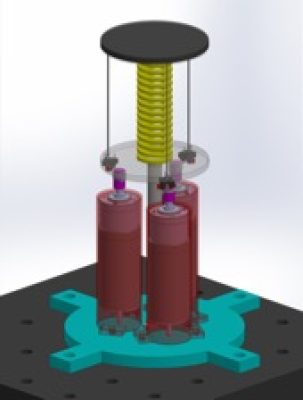
The main objective of the HUMASoft project is the development of a new type of links to
create softer humanoid robots that meet the characteristics of simplicity, accessibility and
safety. These soft links may be used interchangeably in various limbs of the humanoid
robots, like arms, neck and spine, under the constraints of scalability, controllability of their
stiffness and integration. To achieve this goal, the project proposes the following subobjectives:
1) design and development of a prototype of soft link with definition of its material
and its actuation system. As a result the electromechanical prototype will be obtained with
the premise of easy integration into the rigid structure of a humanoid robot; 2) reconfigurable
embedded control system for the soft link, using fractional order and robust control
techniques. As a result a controller easily implementable in i_TEO will be obtained; 3)
substitution (integration) of various links of the life-size humanoid robot TEO by soft links
properly scaled to act like arms, neck and spine. As a result a new soft humanoid will be
available; and 4) final evaluation of the system, developing new metrics for the analysis of
the behaviour of the soft robot, especially in human-robot interaction.
This project is aligned with the Horizon 2020 Call ICT-2016 Work Programme, which
specifically focuses on technological challenges for soft robotics related to manipulation,
safety and interaction. These challenges represent a major innovation in traditional robotics
and other emerging sectors.
Source code at GitHub: https://github.com/HUMASoft