Continuous Goal-Directed Actions (CGDA)

cgda

Description

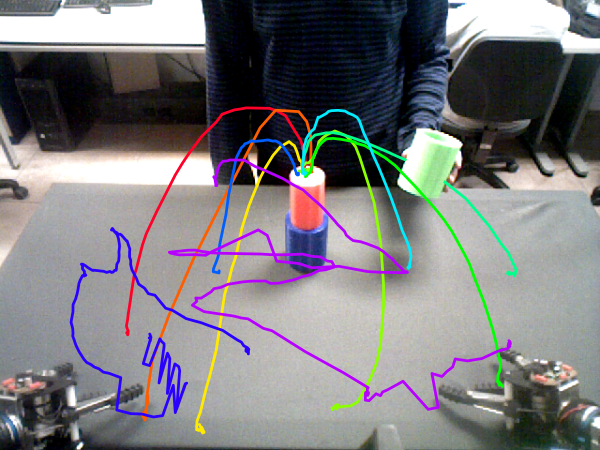
The search for the Grial of generalizing robot actions continues! In Continuous Goal-Directed Actions (CGDA), our robot imitation framework, an action is modelled as the changes it produces on the environment. First, record all the features you can off some user demonstrations. By features, we mean features! The robot joint q2 angle, a human hand Z coordinate, the percentage of a wall painted, the square of the room temperature plus ambient noise… Throw in a demonstration and feature selection algorithm, let it decide which demonstrations were consistent, and which features are relevant. You now have an action encoded as a CGDA model, which is essentially a multi-dimensional time series. As described in its first conference paper, recognition can be performed using costs such as those extracted by DTW, and execution can be achieved by evolutionary algorithms in a simulated environment. While we have performed some work in combining sequences of random movements, we are mostly content with the evolutionary strategies we later developed, such as IET. Additional references include the original S. Morante PhD thesis.


Entries:
A model-free approach for accurate joint motion control in humanoid locomotion
International Journal of Humanoid Robotics. num. 1 , vol. 8 , 2011
J. Villagra
Humanoid Robot RH-1 for Collaborative Tasks. A Control Architecture for Human-Robot Cooperation
Applied Bionics and Biomechanics. num. 4 , vol. 5 , pages: 225 – 234 , 2009
C.A. Monje P. Pierro

Entries:
O. Stasse; A. Kheddar; K. Yokoi. Humanoid feet trajectory generation for the reduction of the dynamical effects
The 9th IEEE-RAS International Conference on Humanoid Robots (Humanoids '09), Paris, France
P. Pierro
A Human-Humanoid Interface for Collaborative Tasks
Second workshop for young researchers on Human-friendly robotics, Sestri Levante, Italy
P. Pierro M. González-Fierro D. Hernandez
A Practical Decoupled Stabilizer for Joint-Position Controlled Humanoid Robots
The 2009 IEEE/RSJ International Conference on Intelligent RObots and Systems (IROS '09), St. Louis, USA
D. Kaynov P. Pierro
The Virtual COM Joints Approach for Whole-Body RH-1 Motion
18th IEEE International Symposium on Robot and Human Interactive Communication (RO-MAN '09), Toyama , Japan
P. Pierro C.A. Monje
Performing collaborative tasks with the humanoid robot RH-1 – A novel control architecture
12th International Conference on Climbing and Walking Robots and the Support Technologies for Mobile Machines (CLAWAR '09), Istanbul, Turkey
P. Pierro C.A. Monje
Pose Control of the Humanoid Robot RH-1 for Mobile Manipulation
14th International Conference on Advanced Robotics (ICAR '09), Munich, Germany
P. Pierro C.A. Monje
Capítulo: “Realización de tareas colaborativas entre robots humanoides. Experimentación con dos robots Robonova”
At Proceedings of the V Workshop ROBOCITY2030. Cooperación en Robótica, 2009, Madrid, Spain
D. Herrero P. Pierro A. Jardon
Modelling and Control of the Humanoid Robot RH-1 for Collaborative Tasks
IEEE RAS/RSJ Conference on Humanoids Robots, Daejeon, Korea
P. Pierro C.A. Monje
Robots in future collaborative working environments
First workshop for young researchers on Human-friendly robotics, Napoli, Italy
P. Pierro
HUMAN-HUMANOID ROBOT COOPERATION IN COLLABORATIVE TRANSPORTATION TASKS
11th International Conference on Climbing and Walking Robots and the Support Technologies for Mobile Machines (CLAWAR 2008), 2008, Coimbra, Portugal
M. Arbulu
Trends of new robotics platform, designing Humanoid Robot Rh-1
CARS & FOF 0723rd ISPE International Conference on CAD/CAM Robotics and Factories of the Future, 2007, Bogota, Colombia
M. Arbulu D. Kaynov L.M. Cabas P. Staroverov
Nuevas tendencias en plataformas de robótica, caso robot humanoide Rh-1
Intercon 2007XIV Congreso Internacional de Ingeniería Eléctrica, Electrónica y Sistemas, 2007, Piura, Peru
M. Arbulu D. Kaynov L.M. Cabas P. Staroverov
ZMP Human Measure System
8th International Conference on Climbing and Walking Robots (Clawar'2005), London, United Kingdom
M. Arbulu D. Kaynov P. Staroverov
Rh-0 Humanoid Robot Bipedal Locomotion and Navigation Using Lie Groups and Geometric Algorithms
International Conference on Intelligent Robots and Systems (IROS'2005), Edmonton, Canada
J. M. Pardos-Gotor
Humanoid Robot Kinematics Modeling Using Lie Groups
7th International Conference on Climbing and Walking Robots (Clawar'2004), Madrid, Spain
J. M. Pardos-Gotor
Lie Groups and Lie Algebras in Robotics.
University Carlos III of Madrid – ROBOTICSLAB SEMINAR., Madrid, Spain
J. M. Pardos-Gotor

Projects

Robots

Robot types & applications