

Arm control / Planning

manfredarm

Description

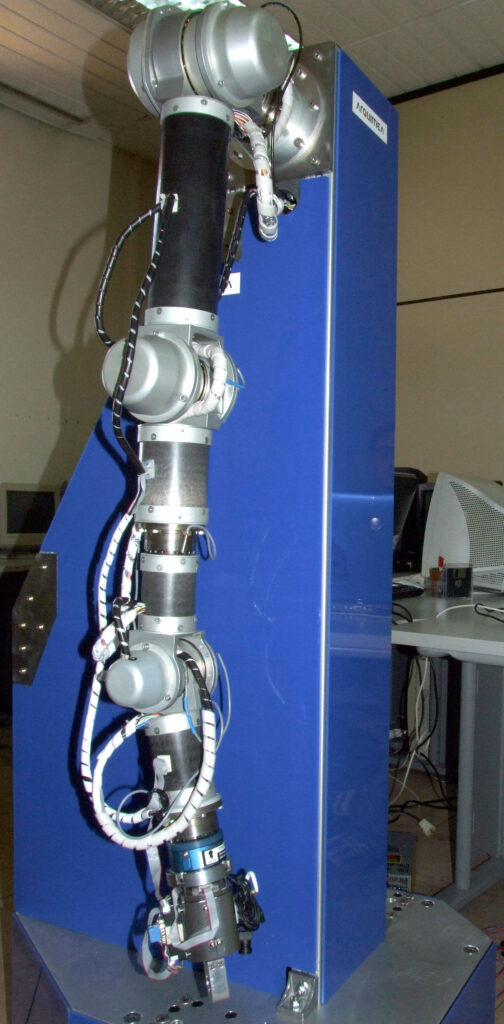
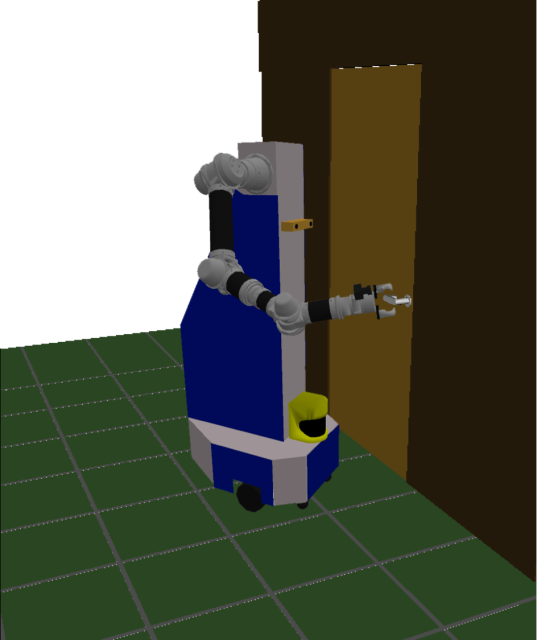
The Light Weight Robot UC3M-1 (LWR-UC3M-1) is a robotic arm with 6 degrees of freedom that allows the robot to do manipulation tasks in human environments. Its main features are the following:

  • Kinematic chain similar to the human one.
  • Total weight of 18 kilograms.
  • Maximum load capability of 4.5 kilograms at the end effector.
  • Maximum distance reached around 955 millimeters.

The low-level control of the arm is done with a PMAC PCI control target which allows simultaneous control of 8 motors. Besides, different high level kinematic control techniques have been developed in order to generate the required trajectories for multiple tasks. Among these techniques, the most important ones are:

  • Cartesian control based on the analytical Jacobian matrix, which gives us the relationship between the cartesian velocities at the end effector and the required velocities in the articulations in order to execute the required trajectory. This control scheme is based on the one proposed by Sciavicco y Siciliano in “Modelling and control of robot manipulators”, 2005.
  • Cartesian control based on the the calculation of the inverse kinematics of the manipulator using evolutionary algorithms. In this case, the Differential Evolution algorithm is used to calculate the motors positions that allow the end effector to reach the desired cartesian point in the space.
Laser Scan

Entries:
Force-Torque Sensor-Based Strategy for Precise Assembly using a SCARA Robot
Robotics and Autonomous Systems. num. 8 , vol. 8 , pages: 203 – 212 , 1991

Entries:
Optimum Robot Manipulator Path Generation using Differential Evolution
IEEE Congress on Evolutionary Computation, CEC’09, Trondheim, Noruega
C. G.Uzcategui D. Blanco L. Moreno
A. De Santis, B. Siciliano, The Virtual End-Effectors approach for Human-Robot Interaction
10th International Symposium on Advances in Robot Kinematics, 2006, Ljubljana, Slovenia
P. Pierro
Predesign of an Anthropomorphic Lightweight Manipulator
8th International Conference on Climbing and Walking Robots and the support Technologies for Mobile Machines (CLAWAR 2005), 2005, London, U.K.
S. Kadhim D. Blanco L. Moreno
Lightweight robot design for mobile manipulators
International Conference on MECHATRONICSICOM 2003, 2003, Loughborough, U.K.
S. Kadhim D. Blanco L. Moreno
Sensor-based path planning for a mobile manipulator guided by the human
11th International Conference on Advanced Robotics (ICAR?2003), Coimbra, Portugal
D. Blanco L. Moreno
Sensor-based path planning for a mobile manipulator guided by the humans
11th International Conference on Advanced Robotics, ICAR?03, 2003, Coimbra, Portugal
D. Blanco L. Moreno
Path planning with uncertainty
18th Int. Conf. on CAD/CAM, Robotics and Factories of the futureCARS&FOF 2002, Oporto, Portugal
L. Moreno
Active human-mobile manipulator cooperation through intention recognition
IEEE International Conference on Robotics and Automation (ICRA'01), 2001, Seoul, Korea
D. Blanco M.A. Salichs
Active Human-Mobile Manipulator Cooperation Through Intention Recognition
IEEE International Conference on Robotics and Automation, 2001, Seoul, Korea
D. Blanco C. Balaguer M.A. Salichs
Kinematic Control of a Redundant Nonholonomic Mobile Manipulator for Singularity Avoidance.
9th International Conference on Advanced Robotics, ICAR´99, 1999, Tokyo, Japan
D. Blanco M.A. Salichs
On-line Identification of Dynamic Systems with Restricted Genetic Optimization
4th IFAC Workshop on Algorithms and Architectures for Real-Time Control, 1997, Vilamoura, Portugal
L. Moreno M.A. Salichs
A multisensor robot system for precise assembly based on force-torque compliance control strategy
IEEE International Workshop on Sensorial Integration for Industrial Robots (SIFIR?89), Zaragoza, Spain
Teaching Robot Planners Using a Practical Approach
15th International Technology, Education and Development , 2021, Online,
A. Mora R. Sánchez R. Barber

Previous Research topics

next Research topics