
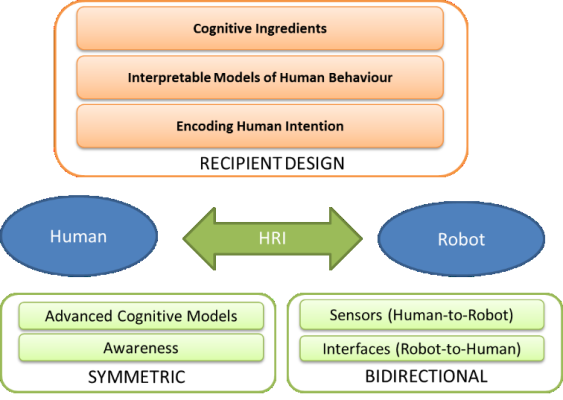
SHARON aims to develop human-centric Artificial Intelligence (AI) models, driven by principles from cognitive sciences and explainable, to enable symmetric and bidirectional interaction between humans and robots (physical AIs).
The starting point of the project is the capability of recipient design in human-human communication, which allows humans to take the perspective of their interlocutors and shape their actions accordingly. Transferring this capability to the scenario of Human-Robot Interaction (HRI) is an open problem and requires that both agents build, maintain and continuously update awareness models about their interlocutors, and use those models to decide their next actions. SHARON will tackle this goal through novel AI cognitive and interpretable models of human behavior, including capabilities of encoding human intention, novel bidirectional communication interfaces and, in summary, a more symmetric HRI. We have selected the domain of healthcare and assistive robotics for patients with sensorimotor disabilities to assess the how the developed technology meets our goals concerning interpretability, symmetry, bidirectionality and trustworthiness in HRI.
We propose a transdisciplinary approach, in which knowledge will transcend the boundaries of research disciplines to develop a unified technology. Particularly, SHARON pivots around two research fields: machine learning and computer vision, as supporting fields of artificial intelligence, and robotics. However, it will also establish links to other disciplines, such as cognitive sciences and medical sciences.
SHARON is aligned with the current vision of a more human-centric and trustworthy AI. Although current AI technology shows impressive performance at solving many tasks, even surpassing human capabilities, it remains far from achieving intelligent machines that think, learn and behave as humans, what hinders its broad social adoption.