

The hand plays a crucial role in the relation between the human being and the environment. The importance of manipulation tasks in aspects of everyday life is huge. The handling capacity is essential to preserve the autonomy and quality of life of people. Nevertheless, the hand is a fragile limb, and a large number of diseases and musculoskeletal and neurological disorders result in total or partial loss of hand mobility. Hence the importance of rehabilitation therapies designed to recover and/or maintain the mobility of the limb.
Rehabilitation engineering has carried out a great effort in recent years in order to develop new technologies that should help to recover mobility and handling capacity.The technological advances in this area have been very remarkable. Among the most promising technologies, it is considered that therapies with robotic exoskeletons are very beneficial for the rehabilitation of patients that require repetitive treatments in order to learn movements that were previously lost.
The vast majority of conventional robotic devices for hand rehabilitation have been based on rigid, heavy and uncomfortable electromechanical components. Among their primary design goals, the new devices should consider patient comfort, low weight and cost reduction to allow a widespread use. It is necessary to investigatecompact, lightweight, portable and affordable solutions that allow these tools to be accessible to general public.
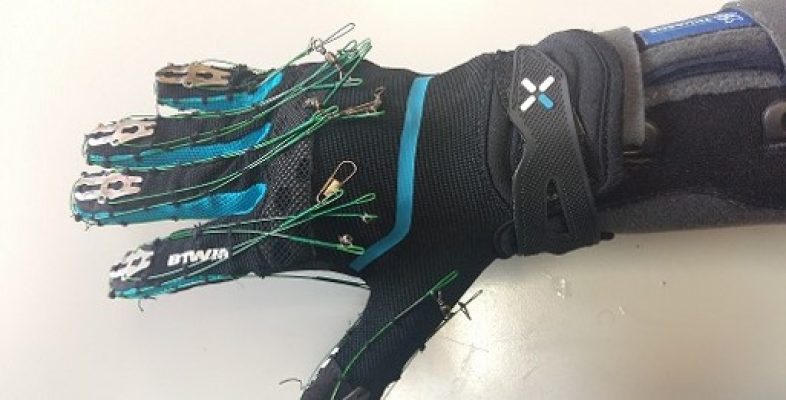
The main objectiveof the EDAM project is to develop a hand exoskeleton where all fingers could be individually moved. The actuating system will be based on SMA (Shape Memory Alloys) wires. A complete sensor system will be implemented on the device to give the therapists a quantitative measurement of the rehabilitation exerciseperformance that could be used in the diagnosis and evaluation of the patient’s evolution. The SMA-based solution will imply weight and volume reduction, improving the patient’s comfort and the system portability.