
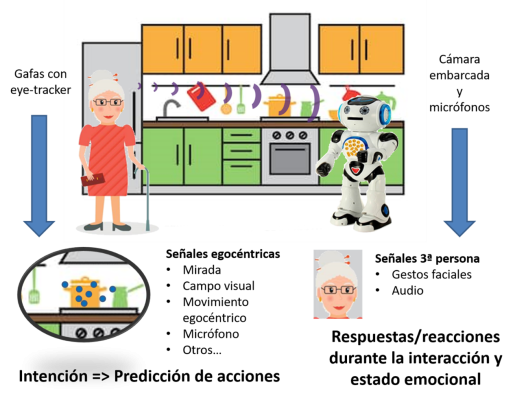
The main objective of the project is the development of a training platform integrated into the humanoid robot TEO, developed at the UC3M, so that its artificial intelligence learns during its interaction with humans and personalizes the HRI (Human-Robot Interaction) between them. The learning system will rely on the development of a series of disruptive enabling technologies in the field of AI and will incorporate features typical of human communication, such as recipient design (interlocutor model, intention prediction, emotional state, etc.), and mechanisms to improve the interpretability of the robot’s behavior by humans.
The project aims to apply its developments in the field of more socially engaging and trustworthy assistive robotics for a group of patients with reduced mobility, cognitive impairments, and/or limited language capacity, who require assistance from a robot in residential or hospital environments.
The research leading to these results has received funding from COMPANION-CM, Inteligencia artificial y modelos cognitivos para la interacción simétrica humano-robot en el ámbito de la robótica asistencial, Y2020/NMT-6660, funded by Proyectos Sinérgicos de I+D la Comunidad de Madrid.