

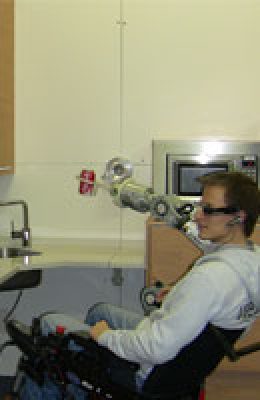
This project will be focused on the development of a new concept of assistential domestic and robotic environment that will allow people with special necessities, on one hand, to increase their capacity of manipulating different objects (spoon, can, dish, book, glasses, brush) and, on the other hand, to increase their cognitive and haptics abilities while performing daily routines (cooking, eating, washing, self-cleaning). Household area will have ubiquity through a sensor net and through a group of identifiers distributed to control its own state as well as that of the user. It will be connected to the net in order to provide any kind of teleassistance and teleoperation.
One of the most important scientific goals of this project is to develop a new robotic assistant which will include novelties: a) portability, thanks to its ultralight design, the use of new materials and the optimization of its structure, b) its mobility capacity affecting the static environment as well as on the wheelchair, c) it is safe for people thanks to a new concept of actuation design, d) its inner handling through multimodal interfaces for different types of users, e) its adaptability, thanks to its sensorial system that is embedded as well as placed in the environment.
The robot assistant will also have a high level of cognitive interaction with the user thanks to an advanced learning system and to its ability of taking decisions “Simultaneous users learning and task execution”. The system will have many learnt methods that can be real-time updatable: from the user, his abilities, from the performed tasks, from the environment and from the use of the robot’s tools. So, the user will be the nucleus of the system and he will be included in the control and learning loops (user-in-the-loop). All of these will allow people with special necessities to live in an autonomic way in their houses without a constant human assistance.