

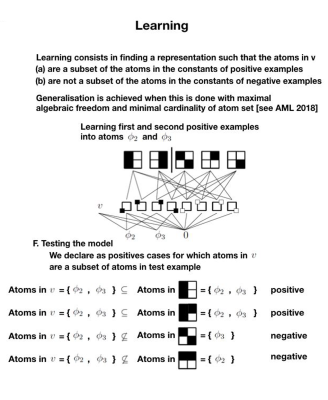
Algebraic Machine Learning (AML) has recently been proposed as new learning paradigm that builds upon Abstract Algebra, Model Theory. Unlike other popular learning algorithms, AML is not a statistical method, but it produces generalizing models from semantic embeddings of data into discrete algebraic structures, with the following properties:
- P1: Is far less sensitive to the statistical characteristics of the training data and does not fit (or even use) parameters
- P2: Has the potential to seamlessly integrate unstructured and complex information contained in training data, with a formal representation of human knowledge and requirements;
- P3. Uses internal representations based on discrete sets and graphs, offering a good starting point for generating human understandable, descriptions of what, why and how has been learned
- P4. Can be implemented in a distributed way that avoids centralized, privacy-invasive collections of large data sets in favor of a collaboration of many local learners at the level of learned partial representations.
The aim of the project is to leverage the above properties of AML for a new generation of Interactive, Human-Centric Machine Learning systems., that will:
- Reduce bias and prevent discrimination by reducing dependence on statistical properties of training data (P1), integrating human knowledge with constraints (P2), and exploring the how and why of the learning process (P3)
- Facilitate trust and reliability by respecting ‘hard’ human-defined constraints in the learning process (P2) and enhancing explainability of the learning process (P3)
- Integrate complex ethical constraints into Human-AI systems by going beyond basic bias and discrimination prevention (P2) to interactively shaping the ethics related to the learning process between humans and the AI system (P3)
- Facilitate a new distributed, incremental collaborative learning method by going beyond the dominant off-line and centralized data processing approach (P4)