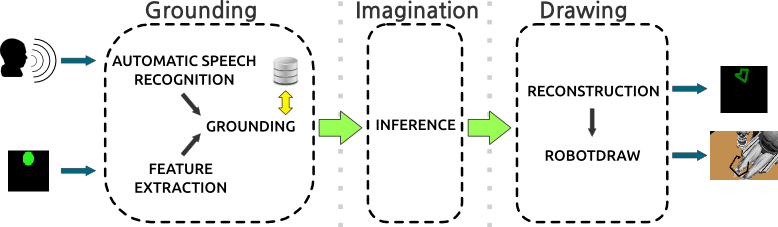
Robot Imagination System (RIS)

ris

Description

Take a look at most machine learning algorithms, when trying to get something novel, you’ll most probably get an average off what you already have. Robot Imagination, as described in its first international conference paper, aims to generate novel mental models of objects given a previous phase of semantic supervised training. Some improvements can be seen in posterior contributions. The transition to actions would not be easy, and it eventually lead to the foundations of CGDA research. Additional references include the original J.G.Victores PhD thesis.


Entries:
Towards Robotic Garment Folding: A Vision Approach for Fold Detection
IEEE International Conference on Autonomous Robot Systems and Competitions (ICARSC), 2016, Bragança, Portugal
D. Estévez Juan G. Victores S. Morante
Robotic Ironing With a Humanoid Robot Using Human Tools
IEEE International Conference on Autonomous Robot Systems and Competitions (ICARSC), 2017, Coimbra, Portugal
D. Estévez R. Fernandez-Fernandez Juan G. Victores
Improving and Evaluating Robotic Garment Unfolding: A Garment-Agnostic Approach
IEEE International Conference on Autonomous Robot Systems and Competitions (ICARSC), 2017, Coimbra, Portugal
D. Estévez R. Fernandez-Fernandez Juan G. Victores
Robotic Ironing with 3D Perception and Force/Torque Feedback in Household Environments
2017 IEEE/RSJ International Conference on Intelligent Robots and Systems (IROS), 2017, Vancouver, Canada
D. Estévez Juan G. Victores R. Fernandez-Fernandez

Entries:
RoboCity16: Open Conference on Future Trends in Robotics
chapter: Future Trends in Perception and Manipulation for Unfolding and Folding Garments pages: 333 – 340. CSIC , ISBN: 978-84-608-8452-1, 2016
D. Estévez Juan G. Victores
RoboCity16: Open Conference on Future Trends in Robotics
chapter: A New Generation of Entertainment Robots Enhanced with Augmented Reality pages: 129 – 136. CSIC , ISBN: 978-84-608-8452-1, 2016
D. Estévez Juan G. Victores C. Balaguer

Robot types & applications